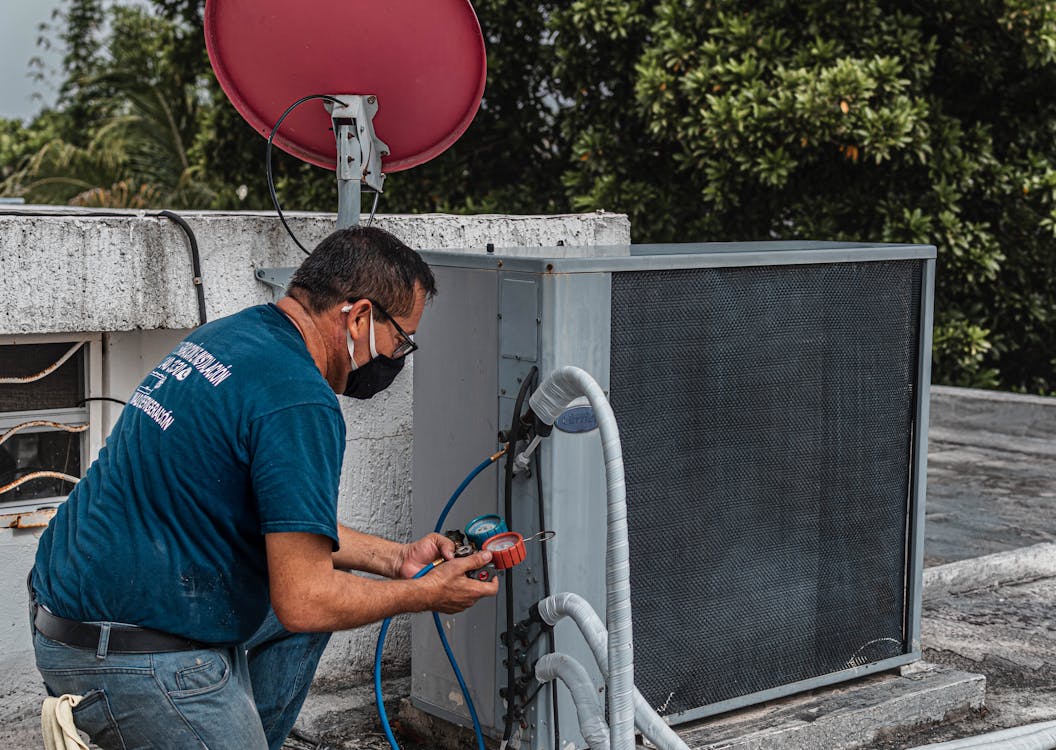
Most AC repairs cost $150 to $650, and a diagnostic visit runs $75 to $200 (Angi, 2026). But an AC running without cold air is usually a free fix: a thermostat set to FAN, a clogged filter, a tripped breaker, or a dirty condenser coil. Check those four first. They take minutes, the same first steps a pro takes.
Safety first
- Turn the power off before you open any access panel. Use the breaker and the outdoor disconnect switch near the condenser unit. Capacitors inside the outdoor unit store a charge even with the power off. Do not touch them.
- Never open the refrigerant lines. Refrigerant is under high pressure and is toxic if mishandled. Federal law (EPA Section 608 of the Clean Air Act) requires certified technicians to handle it. Every refrigerant job in this guide is pro-only.
- Do not hose down the indoor unit or any electrical component. Water goes on the outdoor condenser coil only, with the power off.
- If you see ice on the indoor coil or the refrigerant lines, turn the system off. Running a frozen system can damage the compressor, the most expensive part in it.
Tools you’ll need
- Replacement air filter, the correct size for your system, printed on the old filter’s frame (cause 2). A standard filter costs $10 to $50 (Angi, 2026).
- Flashlight, to see the indoor coil and the outdoor unit in a dark closet, attic, or yard.
- Garden hose with a gentle spray nozzle, to rinse the outdoor condenser coil (cause 4). Never use a pressure washer on a coil; it bends the fins.
- Screwdriver, to remove the outdoor unit’s access panel if you need to look for ice on the lines.
- Wet/dry vacuum or towels, for the small amount of water from clearing the condensate drain line (cause 5).
The causes, ranked most likely first
1. Thermostat set wrong or dead batteries, most common
How to tell: The system runs, but the air is room temperature or only slightly cool. The thermostat display is blank, the setting is wrong, or the fan is set to ON instead of AUTO.
The fix: Confirm the thermostat is set to COOL, not HEAT or FAN. Fan-only mode blows air continuously whether or not the compressor is running, so it feels like the AC is on when it is not cooling at all.
Set the fan to AUTO, not ON, with the fan ON, the blower keeps running between cooling cycles and pushes room-temperature air through the vents.
Set the temperature at least 3 to 5 degrees below the current room temperature, then wait 5 to 10 minutes. If the air from the vents gets cold, you found it. If the thermostat display is blank, replace the batteries and check the breaker for the indoor unit (cause 3).
Cost: $0 for the setting fix. Batteries cost a few dollars. A pro thermostat replacement typically costs $140 to $350 (HomeGuide, 2026).
2. Dirty or clogged air filter
How to tell: Airflow from the vents is weak as well as warm, and the filter looks gray or matted with dust when you pull it out.
The fix: Find the filter, in the return air grille, in the air handler, or in a slot in the ductwork near the furnace.
Pull it out and hold it up to a light. If you cannot see light through it, replace it, matching the size printed on the frame.
Slide the new filter in with the arrow pointing toward the blower and wait 15 to 30 minutes. If the air is cold again, you found it.
From now on, replace a standard filter every 60 to 90 days, and monthly during heavy summer use.
Cost: $10 to $50 for a replacement filter (Angi, 2026). This is the cheapest fix on the list and the most often skipped.
3. Tripped breaker, blown fuse, or disconnect switched off
How to tell: The indoor fan may run, but the outdoor unit is silent, no hum, no fan spinning. Or nothing runs at all.
The fix: Go to your breaker panel and find the breakers for the AC, usually one for the indoor air handler and one for the outdoor condenser. Reset any tripped breaker (it will sit in the middle position, not fully on). Flip it fully off, then back on.
Check the outdoor disconnect switch, the gray box mounted on the wall near the condenser unit. Make sure it is fully seated, it can get bumped off during yard work.
Check the indoor furnace/air handler switch, which looks like a regular light switch on or near the unit. It is easy to mistake for a light switch and turn off by accident.
If a breaker trips again immediately after you reset it, stop. A breaker that will not stay on means a shorted component or a wiring fault. That is a pro job.
Cost: $0 for the reset. A pro fuse or breaker replacement typically costs $75 to $300 (HomeGuide, 2026).
4. Dirty or blocked outdoor condenser unit
How to tell: The outdoor unit is running, but the air it blows out the top is not noticeably warm, it should be, since the condenser dumps your home’s heat outside. Grass clippings, leaves, or dirt are packed into the coil fins, or shrubs are crowding the unit.
The fix: Turn the power off at the breaker and the outdoor disconnect switch.
Clear leaves and debris from around the unit and trim shrubs back so there is at least 2 feet of clearance on all sides.
Rinse the coil fins gently with a garden hose, never a pressure washer, which bends the fins shut and makes the problem worse.
Restore power and wait 15 to 30 minutes. If the air from the vents is cold, you found it.
Cost: $0 if you do it yourself. A pro coil cleaning typically costs $100 to $400 (HomeGuide, 2026).
5. Frozen evaporator coil
How to tell: You can see ice on the indoor coil, on the copper refrigerant lines, or on the outdoor unit, and airflow is very weak or stopped.
The fix: Turn the cooling OFF at the thermostat, but set the fan to ON. Running the fan circulates warm room air over the coil and thaws it. Do not try to chip the ice off. You will damage the coil fins.
Thawing takes several hours. While you wait, replace the filter (cause 2) and open any closed supply vents.
Once the ice is gone, turn cooling back on and watch it for a few hours. If it freezes again, stop, a repeat freeze means a mechanical or refrigerant problem, and running a frozen system can damage the compressor.
Cost: $0 for the thaw and filter change. If a pro has to find the underlying cause, a diagnostic visit typically costs $75 to $200 (HomeGuide, 2026).
6. Low refrigerant (a leak, not a top-off)
How to tell: The system runs constantly but never reaches the thermostat setting, the air from the vents is only slightly cool, and the larger copper refrigerant line is covered in ice or frost. Low refrigerant also causes the coil to freeze (cause 5).
The fix: None for a homeowner. Refrigerant circulates in a sealed system, it never gets “used up”, in normal operation, so low refrigerant always means a leak. A licensed HVAC tech has to find the leak, repair it, and then recharge the system. Do not use a DIY recharge kit. It cannot fix the leak, and it can damage the system.
Before you approve the quote, R-410A costs $50 to $80 per pound installed, while older R-22 costs $90 to $150 per pound installed, and R-22 is being phased out, so prices keep rising. Ask whether the quote includes leak detection, because a recharge without a leak repair will leak out again.
Cost: A recharge alone typically costs $100 to $600. Finding and fixing the leak plus the recharge typically costs $200 to $1,500 (HomeGuide, 2026).
7. Failed capacitor or contactor
How to tell: The outdoor unit hums but the fan or compressor will not start, or the unit tries to start and stutters, clicks, or shuts off after a few seconds.
The fix: This is a pro job for most homeowners. A capacitor swap looks simple, but capacitors store a charge even with the power off, and a wrong replacement can damage the compressor. A tech can test the capacitor and contactor with a multimeter and replace the faulty part in under an hour.
Cost: A capacitor replacement typically costs $100 to $250 (HomeGuide, 2026). A contactor replacement typically costs $200 to $450 (HomeGuide, 2026).
8. Failed compressor, fan motor, or control board
How to tell: Everything else checks out, thermostat, filter, power, condenser, no ice, refrigerant fine, but the air is still warm, the compressor is silent, or the outdoor unit will not start at all.
The fix: None for a homeowner. Compressor, blower motor, condenser fan motor, and control board replacement are pro jobs. A tech will test each component, check the refrigerant charge, and tell you whether a repair or a replacement makes sense. A failed condenser fan motor leaves the compressor running without airflow over the coil, and the system quickly blows warm and may shut down on its protection.
Cost: A compressor replacement typically costs $600 to $2,500 (HomeGuide, 2026), $600 to $1,200 if the part is still under warranty, $1,800 to $2,800 if it is not. Angi puts the range at $800 to $3,000. A blower motor replacement typically costs $300 to $900, a condenser fan motor $200 to $700, and a control board $150 to $700 (HomeGuide, 2026).
When to call a pro
Call a licensed HVAC tech. Do not keep troubleshooting if:
- The coil freezes again after you thaw it and replace the filter.
- A breaker trips again after you reset it, or you see burnt wiring, a burning smell, or a scorched disconnect box.
- The system needs refrigerant, a capacitor, a contactor, or any part inside the outdoor unit’s electrical panel.
- The compressor is making grinding, screeching, or loud buzzing noises, or it will not start at all.
- The repair quote is more than half the price of a comparable new system (see below).
What a pro typically costs
These are typical 2026 ranges from Angi and HomeGuide contractor data (AC repairs average $350 to $4,500, most common fixes land between $150 and $650, and the full range runs $100 to over $3,000). Ask whether the diagnostic fee is applied to the repair before you approve the work. For a tailored estimate, run the numbers on the AC cost calculator.
| Repair | What a pro typically costs |
|---|---|
| Diagnostic visit | $75 to $200 |
| Thermostat replacement | $140 to $350 |
| Capacitor replacement | $100 to $250 |
| Contactor replacement | $200 to $450 |
| Refrigerant recharge (R-410A) | $100 to $320 |
| Refrigerant recharge (R-22, older systems) | $180 to $600 |
| Refrigerant leak repair (find, fix, recharge) | $200 to $1,500 |
| Coil cleaning | $100 to $400 |
| Condensate drain line flush | $75 to $250 |
| Evaporator coil replacement | $1,000 to $4,500 |
| Condenser fan motor replacement | $200 to $700 |
| Blower motor repair | $300 to $900 |
| Circuit board replacement | $150 to $700 |
| Compressor replacement | $600 to $2,500 (Angi: $800 to $3,000) |
| Full central AC replacement, installed | $5,000 to $8,300 |
Every figure above also lives in the Home Repair Cost Index, in the HVAC section, next to the furnace and thermostat guides.
Repair or replace?
Repair it if the system is under 10 years old, the fix is a single part (filter, capacitor, contactor, thermostat, fan motor), and the quote is well under half the price of a new system.
Replace it if the system is over 15 years old and needs a compressor or evaporator coil, if it uses R-22 refrigerant (phased out, and now very expensive to recharge), or when you are facing a second major repair in two seasons.
The $5,000 rule: Multiply the system’s age in years by the repair quote; if the answer is over $5,000, replacement is usually the better call. A new central AC typically costs $5,000 to $8,300 installed (HomeGuide, 2026); Angi’s repair-versus-replace table puts replacement at $3,800 to $7,500.
Do not let a repair quote turn into a full-system upsell unless the numbers support it. A $250 capacitor on a 6-year-old system is a repair, full stop.
For the full decision, see the repair or replace page. If your problem is a dead screen, start with the thermostat blank screen guide instead, and if the furnace will not heat in winter, the furnace not turning on guide covers the heating side.
FAQ
Why is my AC running but not blowing cold air?
The most common causes are a thermostat set to FAN instead of COOL, a clogged air filter, a tripped breaker to the outdoor unit, and a dirty condenser coil. Work through the ranked list in order; most homeowners find the cause in the first three.
Why does my AC blow warm air in the afternoon but cold air at night?
That pattern points to capacity loss rather than a dead part: a dirty condenser coil, low refrigerant, or an undersized system struggling in peak heat. Clean the coil, check the filter, and if the problem persists, have a tech check the refrigerant charge.
Can I add refrigerant myself?
No. Refrigerant work is pro-only under federal law, and a DIY kit cannot find or fix the leak that caused the low charge. A recharge without a leak repair will leak out again, usually within weeks.
Why does my AC freeze up?
The two usual triggers are restricted airflow (a dirty filter or closed vents) and low refrigerant. Thaw the coil with the fan on, fix the airflow problem, and if it freezes again, call a pro. Running a frozen system can damage the compressor.
How often should I change my AC filter?
Every 60 to 90 days for a standard filter, and monthly during heavy summer use, per ENERGY STAR’s guidance. Check it monthly, a filter that looks gray is already overdue.
How long does an AC repair usually take?
Most of the fixes in this guide are diagnostic visits plus a single part swap, and the common fixes (thermostat, capacitor, contactor, filter, coil cleaning) are typically done in a single visit one to two hours, once the tech is on site.
Sources: HomeGuide, “How Much Does AC Repair Cost? (2026)” (updated Aug 22, 2025; AC repairs average $350 to $4,500, most common fixes land between $150 and $650, full range $100 to over $3,000); Angi, “Cost to Repair an Air Conditioner” (2026 data; AC repairs average $350 to $4,500, most common fixes land between $150 and $650, full range $100 to over $3,000; service call $75–$200, compressor replacement $800 to $3,000, new central AC $3,800 to $7,500); ENERGY STAR, “Guide to Heating and Cooling” (filter replacement frequency).
Related reading
an AC blowing warm air instead of cold: is it the same problem?
Leave a Reply